Planning a Downtown Asheville Reno? How to Get a Dumpster Permit for Street Placement
Renovating in Downtown Asheville or the South Slope sounds like a dream until you realize your property line ends exactly where the sidewalk begins.
If you’re planning a project in the Central Business District or historic Montford, you’ve likely hit a major wall: there is nowhere to put a dumpster. Between the metered parking, narrow one-way streets, and constant pedestrian traffic, the logistics are enough to make you want to cancel the contractor. You’re likely worried about getting slapped with a Stop Work order, facing heavy city fines, or having a rental company refuse delivery because you don’t have the right paperwork.
The good news? You don’t have to navigate City Hall alone.
Securing an Asheville dumpster permit for street placement is a manageable process once you know the city’s specific Encroachment rules. In this guide, we’re breaking down exactly how to get your street placement permit, what the city expects for sidewalk safety, and how to keep your downtown renovation moving without the legal headaches.
Why Street Dumpster Permits Are Common in Downtown Asheville?
Downtown Asheville is famous for its charm, but for a homeowner or contractor, that charm often means zero clearance. When your property lines end where the sidewalk begins, a street permit isn’t just a suggestion; it’s a logistical necessity.
Limited Driveway Access
Many historic homes in areas like Montford or the South Slope were built before the era of the two-car garage. You might have a narrow alley or a driveway that barely fits a sedan, let alone a 20-yard roll-off truck. When there is physically no off-street dirt or concrete to place a bin, the city’s right-of-way is your only option.
Narrow Streets and Historic Neighborhoods
In neighborhoods like Kenilworth or Chestnut Hill, the streets are often narrow and lined with century-old trees. Placing a dumpster on these roads requires precision to ensure Buncombe County transit and emergency vehicles can still pass. Because these areas are high-traffic, the City of Asheville requires a permit to ensure your bin doesn’t become a safety hazard or a bottleneck for your neighbors.
Renovations Inside Asheville City Limits
If your project is located within Asheville city limits, the rules change. Unlike rural Buncombe County, where you might have acres of space, urban renovations are under constant scrutiny by city inspectors. Placing a dumpster on a public street without an Encroachment Permit is the fastest way to get a Stop Work order and a daily fine that can exceed $1,000.
When Do You Need a Dumpster Permit in Asheville?
In Asheville, the need for a permit is determined entirely by where the dumpster lands. If the bin is on your private property, like a driveway or a side yard, you are generally in the clear. However, once that bin crosses onto city property, the rules change immediately.
Dumpster Placed on a Public Street
If your driveway is too steep, too narrow, or non-existent, and the dumpster must sit on the asphalt of a city-maintained road, you must obtain an Encroachment Permit. This applies whether the bin is there for two days or two weeks. The city requires this to ensure the container doesn’t obstruct emergency vehicles or Buncombe County transit routes.
Blocking Sidewalks or Parking Lanes
Even if the dumpster isn’t in the middle of the road, you need a permit if it occupies:
- Sidewalks: You cannot force pedestrians into traffic. If a bin blocks a walkway, you may also need a Temporary Closure Permit to set up a safe detour.
- On-Street Parking: If you are taking over a metered or unmetered public parking spot, the city needs to authorize that loss of public space.
- The Clear Zone: Asheville code typically requires at least 20 feet of usable street width to remain open. If your bin makes the road too narrow for a fire truck, your permit will likely be denied.
Downtown, River Arts District, and Dense Areas
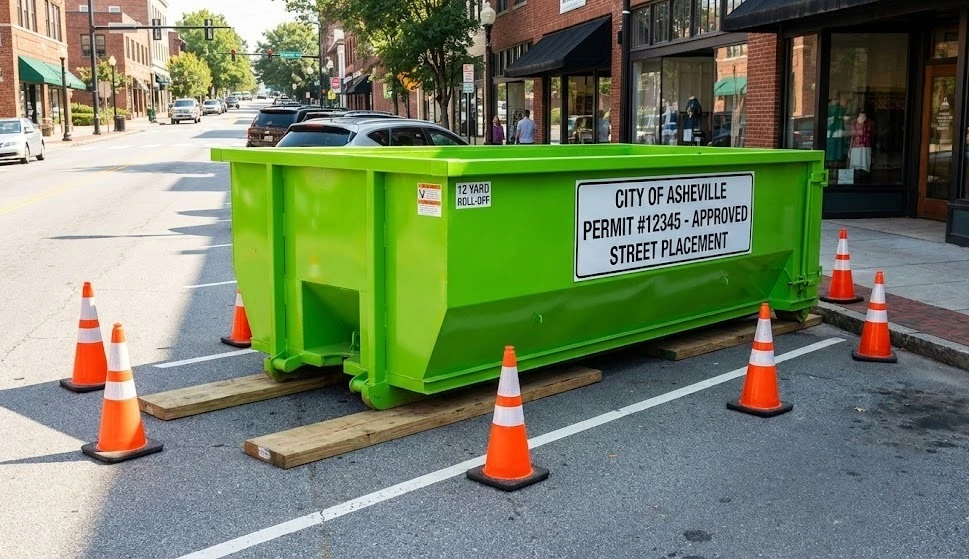
In high-density zones like the River Arts District (RAD) or the Central Business District, the rules are strictly enforced. Because these areas are hubs for tourism and foot traffic, the City of Asheville often limits dumpster sizes (typically to 12 cubic yards or smaller in the CBD) to minimize the footprint. In these tight zones, an unpermitted bin will be flagged by code enforcement almost instantly.
Asheville Dumpster Permit Rules Homeowners Should Know
Getting a permit for your downtown project isn’t just about paying a fee; it’s about following a specific set of safety and urban planning rules designed for Asheville’s unique layout. Here is what you need to keep in mind:
City of Asheville Regulations
If your dumpster sits on a public street, sidewalk, or parking lane, it falls under Encroachment Permit jurisdiction. The city’s primary concern is maintaining a Clear Zone. In residential areas, you must leave at least 20 feet of usable street width so emergency vehicles and city buses can pass. If your street is too narrow to accommodate the bin and this clear zone, your permit will likely be denied.
Permit Duration Limits
A standard Asheville encroachment permit for a dumpster typically lasts for 30 days.
Size and Placement Restrictions
In the Central Business District (CBD) and some high-density areas of the River Arts District, size matters.
How to Apply for a Dumpster Permit in Asheville? (Step-by-Step)
Navigating the paperwork for a downtown project shouldn’t feel like a second job. Here is the direct path to getting your street placement authorized:
Who Issues the Permit?
In Asheville, dumpster permits fall under the Encroachment Permit category. These are issued by the City of Asheville Development Services Department (DSD). You can apply in person at the Permit Application Center (PAC) located at 161 South Charlotte Street or through the city’s online Development Portal.
Typical Approval Timeline
For a standard residential street encroachment, expect a review period of 5 to 10 business days.
Pro-Tip: Don’t wait until the day you need the bin to apply. In 2026, the DSD is strictly enforcing Clear Zone requirements, so getting your approval early ensures your renovation stays on schedule without a hitch.
Information Required for Approval
To avoid a denied status, have these details ready before you start the application:
Site Plan: A simple drawing showing the dumpster’s exact position on the street relative to your property, sidewalks, and the nearest intersection.
Dimensions: The specific size of the bin (e.g., a 10-yard or 12-yard low-profile container).
Traffic Control Plan: If the street is narrow, you must show how you will place safety cones or signage to direct traffic.
Certificate of Insurance (COI): The city typically requires proof of liability insurance that names the City of Asheville as an additional insured.
Downtown Asheville Dumpster Placement Requirements
Placing a dumpster downtown isn’t just about finding a spot; it’s about meeting strict safety and access codes. The City of Asheville monitors right-of-way placements closely to ensure the city remains walkable and safe for everyone.
Safety Cones and Reflective Markings
In high-traffic areas like the South Slope or Broadway St, visibility is everything.
Clearance for Traffic and Pedestrians
Asheville’s Clear Zone rule is non-negotiable.
Distance from Intersections and Fire Hydrants
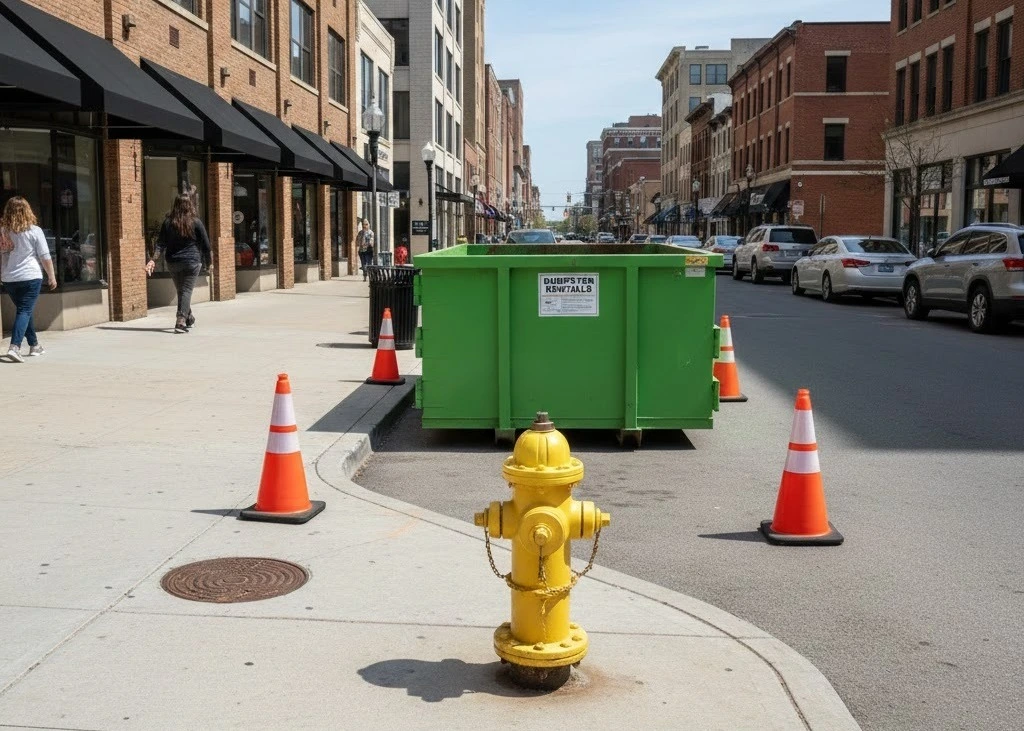
Placement is a game of inches when it comes to public safety.
Common Permit Mistakes That Delay Renovation Projects
Even the best-planned downtown Asheville renovation can grind to a halt due to simple paperwork errors. Avoid these three common pitfalls to keep your project on schedule:
Applying Too Late
The most frequent mistake is treating the permit as an afterthought. The City of Asheville Development Services Department typically requires 5 to 10 business days to review encroachment applications. If you wait until your subcontractors are on-site to apply, you’ll be paying for labor while your crew waits for a place to put the debris.
Incorrect Address or Zone
Asheville has specific overlay districts (like the Historic Montford District or the South Slope) that have stricter aesthetic and placement rules. If your application lists the wrong property PIN or fails to identify that you are in a high-traffic Central Business District zone, the city will bounce the application, forcing you to restart the 10-day waiting period.
Oversized Dumpsters for Tight Streets
It’s tempting to order a 30-yard bin to save on haul fees, but on narrow downtown streets, bigger is rarely better.
What Happens If You Skip the Dumpster Permit?
In Asheville’s high-traffic downtown and historic districts, code enforcement is proactive. Skipping the paperwork might seem like a time-saver, but it almost always results in one of three project-stalling consequences:
City Fines and Citations
The City of Asheville doesn’t just issue warnings for unpermitted street occupancy.
Forced Removal Delays
If a bin is deemed a safety hazard or is unpermitted, the city has the authority to order its immediate removal.
Project Downtime
The most expensive consequence isn’t the fine, it’s the delay.
How Local Dumpster Companies Help With Permit Assistance?
Navigating the Asheville Development Services Department (DSD) can be a full-time job. While the homeowner is technically responsible for the permit, a local partner makes the process significantly smoother. Here is how we help:
Local Knowledge of Asheville Ordinances
We live and work in these mountains. We know which streets in Montford have strict historic preservation rules and which areas of the South Slope are considered High-Traffic Zones by city inspectors. We can advise you on whether your specific address will trigger a Temporary Street Closure requirement or if a standard Encroachment Permit will suffice, saving you from denied applications and wasted fees.
Proper Placement Planning
A permit is only as good as the site plan attached to it. We help you determine the exact footprint of the bin so your application is accurate the first time.
Coordinating Delivery and Pickup Times
The City of Asheville often restricts when dumpsters can be swapped in high-density areas to avoid rush hour or morning delivery windows.
Downtown Asheville Areas That Commonly Require Street Permits
While any street placement within city limits technically requires an Encroachment Permit, certain Asheville neighborhoods are under higher scrutiny due to foot traffic, narrow historic lanes, and density. If your project is in one of these four areas, expect the permit process to be a mandatory part of your planning:
Central Business District (CBD)
The heart of downtown, including Patton Ave, Broadway, and Biltmore Ave, is the most regulated zone in the city.
Montford
As a Historic Overlay District, Montford has strict aesthetic and safety standards. Because many driveways here are shared or extremely narrow, street placement is common. The city ensures that bins in Montford don’t block the deep-set granite curbs or the aging canopy trees that line these historic streets.
River Arts District (RAD)
With the massive redevelopment of the River Arts District, the city is hyper-focused on maintaining Clear Zones for tourists and cyclists. If your bin is near the Wilma Dykeman Greenway or on narrow side streets like Roberts St, you must provide a detailed pedestrian detour plan if your dumpster touches the sidewalk.
South Slope
Known for its breweries and heavy weekend crowds, the South Slope presents a unique challenge: loading zones.
FAQs:
Conclusion: Your Downtown Reno, Simplified
Don’t let Asheville’s narrow streets and strict permitting rules stall your renovation. While the downtown core presents unique challenges, a little planning goes a long way. By securing your