The Asheville Steep Driveway Guide: How We Deliver Dumpsters Safely on Hills
As you know, in Asheville, we don’t really have flat ground; we just have varying degrees of a slant.
If you live in an area like Woodfin or Town Mountain, you know the Asheville Lean. It’s that spike of anxiety you feel when a heavy delivery truck pulls into your neighborhood. You find yourself eyeing your steep driveway and wondering: “Is this even possible? Is that steel bin going to slide? Am I about to have a 6,000-pound box in my living room? Most national dumpster companies treat every delivery like a flat parking lot. They show up, realize your driveway has a 15-degree pitch, and leave you with a non-deliverable fee and a stalled project. We know the stress of worrying about gouged asphalt, high-centered trucks, or a bin shifting during heavy mountain rain.
At Ten Twenty Bins, we don’t fear the hills; we live on them.
We’ve navigated every tight curve from Montford to Fairview. In this guide, we’re breaking down exactly how we deliver dumpsters safely on Asheville’s toughest terrain, from the boards we use for protection to the physics of hillside placement. Here is how we keep your project on level, even when your property is not.
Why Asheville Steep Driveway Dumpster Delivery Requires Local Experience?
National call centers see a zip code; local drivers see the grade. In Asheville, a standard delivery can quickly become a liability if the driver isn’t accustomed to mountain logistics. Here is why local expertise is non-negotiable for hillside placement:
Understanding Hills, Slopes, and Mountain Terrain Across Asheville
In Western North Carolina, no two driveways are the same. Delivering a bin in the Blue Ridge Mountains requires a different strategy than a flat lot in the Midwest. Because Buncombe County’s topography is so varied, we categorize terrain into three distinct challenges:
The Mountain Side (Pisgah Forest Foothills)
Properties bordering the Pisgah Forest foothills often feature switchback driveways. The challenge here isn’t just the steepness, but the tight turn radius. A standard roll-off truck is long; if the driveway has a sharp, uphill curve, the rear of the dumpster can tail-swing into trees or stone walls. We use smaller, more maneuverable trucks for these specific deep mountain deliveries.
The Urban Incline (Asheville City Limits)
Within the Asheville city limits, particularly in historic areas like Montford or Kenilworth, the challenge is the Sidewalk Break. This is the sharp angle where a steep driveway meets a level city street. If the truck’s approach angle is off by even a few degrees, the steel rollers on the back of the dumpster can gouge the sidewalk, or the truck can lose traction.
The Erosion Factor
Asheville’s soil is often heavy in clay or loose shale. On a slope, the ground’s stability changes with the weather. A dumpster that is safe on a dry slope can become a hazard if the feet of the bin sink into soft mountain soil after a storm. We scout the ground density to ensure your bin stays exactly where we put it.
Can a Dumpster Be Put on a Slope? What Homeowners Should Know?
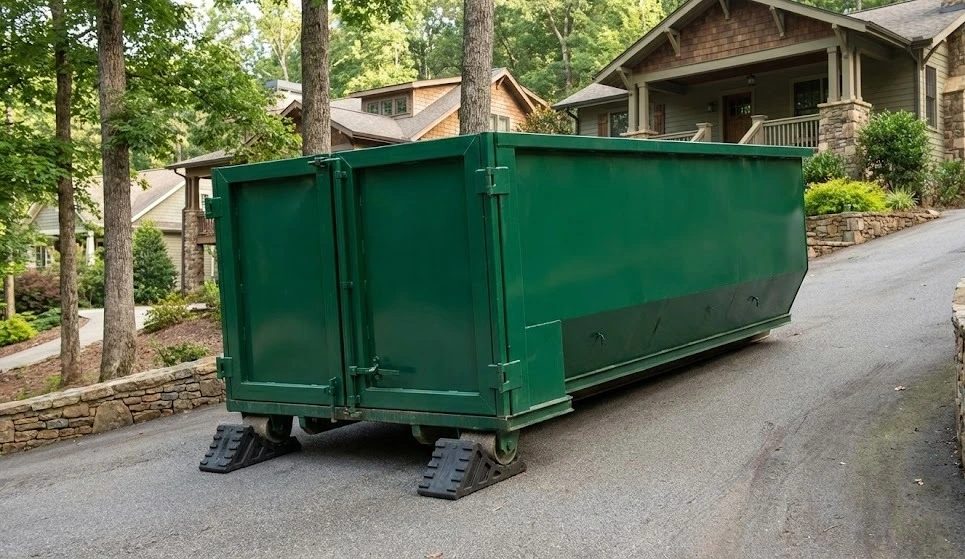
The short answer is yes, but it isn’t as simple as “drop and go.” Placing a multi-ton steel box on an incline changes the physics of the entire project. If you are a homeowner in the Asheville area, here is what you need to consider before the truck arrives:
Pro-Tip:
If you’re unsure if your slope is too steep, take a photo from the side and text it to us. Our drivers can usually tell within seconds if a “hill-side set” is safe for your specific property.
Dumpster Placement on a Hill, Safety Comes First
Placing a dumpster on an incline isn’t just about the drop; it’s about managing thousands of pounds of downward pressure. Safety on an Asheville hillside comes down to two technical factors.
Center of Gravity & Load Distribution
Gravity is your biggest enemy on a slope. To keep the bin anchored, we focus on:
Asphalt vs. Concrete Surface Considerations
The material under the bin dictates how much grip we have:
Roll-Off Dumpster Slope Safety Explained
Delivering a dumpster to a hillside property isn’t just a driving challenge; it’s a precision engineering task. At Ten Twenty Bins, we use specialized equipment designed to fight gravity and keep your property intact.
Roll-Off Hoist and Hydraulic Lift System Control
The hoist is the massive hydraulic arm that slides the dumpster off the truck. On a steep Asheville slope, this system is under extreme tension.
GVW (Gross Vehicle Weight) and Shingle Weight Factors
In the mountains, weight isn’t just a number; it’s a safety variable.
How do We Prevent a Dumpster From Sliding on a Steep Driveway?
Stopping a 10-ton container from sliding down a mountain driveway isn’t just about luck; it’s about physics. We use a multi-layered approach to ensure that once we set a bin, it stays put until the project is finished.
Wheel Chocks and Friction Coefficient Control
The Friction Coefficient is basically a measurement of how much grip there is between the dumpster and your driveway. On a slope, gravity tries to overcome that grip.
2×6 Wood Planking for Added Stability
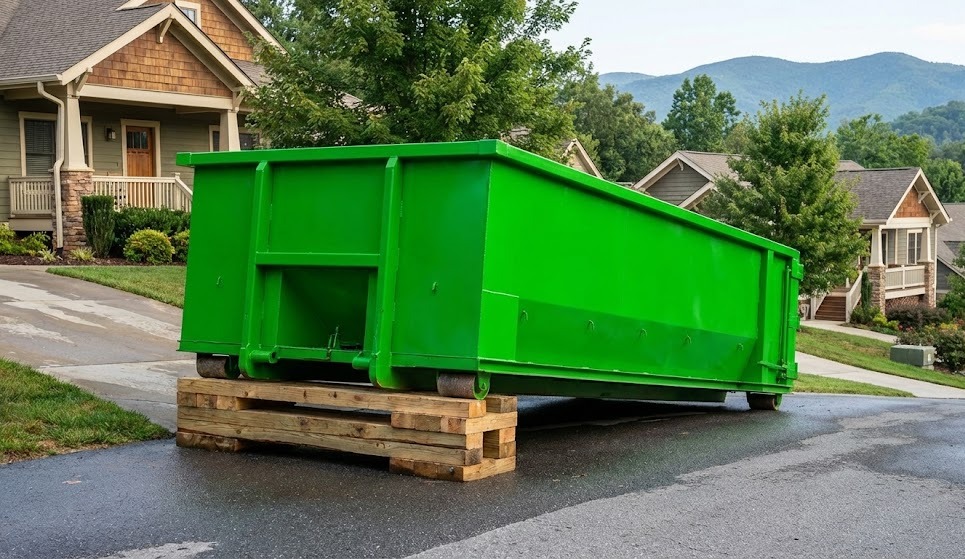
Steel-on-asphalt is surprisingly slippery on a steep grade. We use specialized cribbing, custom-cut 2×6 or 4×4 wooden planks, to act as an anchor system.
Narrow Mountain Road Dumpster Delivery in Western North Carolina
In Western North Carolina, the challenge often starts before we even reach your driveway. Navigating the winding, one-lane roads common in areas like Leicester or Black Mountain requires more than just a GPS; it takes a specialized approach to logistics and equipment.
Tight Access Planning
National companies often dispatch large, 3-axle trucks that simply cannot make the hairpin turns found on many WNC mountain roads. At Ten Twenty Bins, we prioritize:
Safe Approach Angles and Clearance Checks
A narrow road often means a sharp, uphill entrance. If a truck’s overhang is too long, the rear of the vehicle will scrape the pavement before the tires ever hit the incline.
Why WNC Dumpster Rental Hills Demand a Different Approach?
Renting a dumpster in the Blue Ridge Mountains isn’t the same as renting one in the flatlands. In Western North Carolina, the geography dictates the logistics. At Ten Twenty Bins, we don’t just drop a box; we engineer a solution for your specific property.
From managing shingle weight shifts to protecting your driveway from the Asheville Lean, we bring the local experience necessary to handle the terrain safely. Don’t risk a non-deliverable fee from a national chain that doesn’t understand our mountains; choose the local team that’s already mastered your neighborhood.
Frequently Asked Questions: Asheville Hillside Deliveries
Conclusion
Building on a slope shouldn’t be an uphill battle. While Asheville’s terrain presents unique challenges, the right equipment and local expertise make even the steepest driveway a viable spot for a dumpster.
At Ten Twenty Bins, we specialize in the impossible deliveries that national chains won’t touch. By prioritizing driveway protection, using precision hydraulics, and understanding the physics of the Blue Ridge foothills, we ensure your bin stays exactly where we put it. Ready to clear the deck or gut that kitchen without worrying about the Asheville Lean?